
📐 Local systems built around real workloads
LocalPrompt builds and implements local systems for scientific computing, machine learning and private AI, and hands them over ready for independent operation.
The workload comes first. I determine what the system must actually run, select fit-for-purpose hardware, configure Linux and the required software environment, validate the workload and deliver the system ready for use.
The result is not just a workstation. It is a working, documented and recoverable environment that the organisation can operate and maintain without needing LocalPrompt for normal use.
🧪 Implemented in research
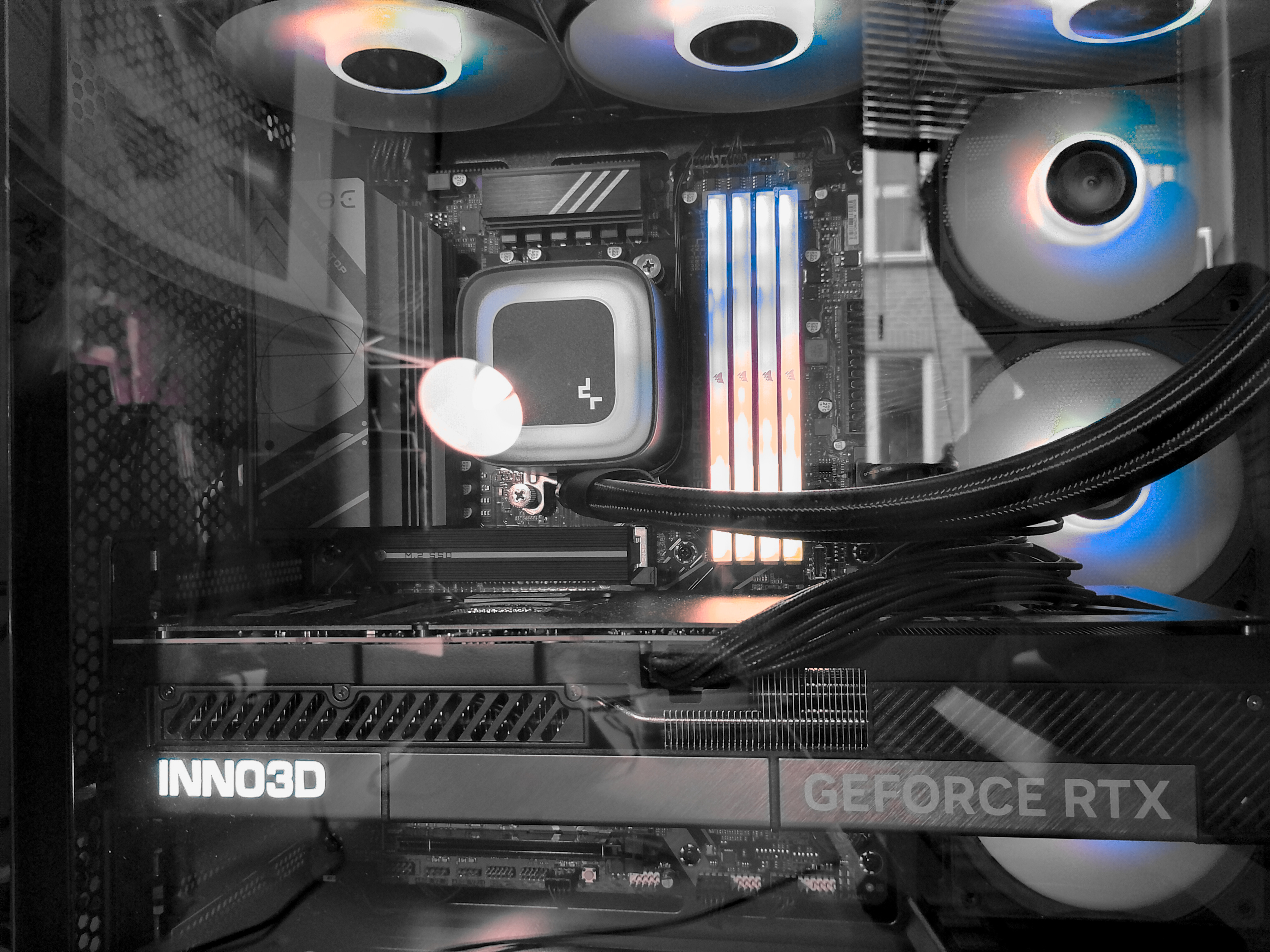
LocalPrompt has designed and implemented three research systems at Wetsus, each built for a different research workload. The systems were configured, validated and handed over for operational use. The first two projects each resulted in a follow-up assignment.
Scientific computing: Operational
The first LocalPrompt system deployed at Wetsus supports PhD research in scientific computing. It is built around an NVIDIA RTX 4080 and a configured Python virtual environment for numerical modelling and related research workflows.
Bioinformatics and programming: Operational
A second system supports bioinformatics on an NVIDIA RTX 5090 workstation with 32 GB VRAM and 128 GB RAM. Micromamba provides isolated and reproducible project environments, while local Codestral LLM inference supports programming work.
Private RAG infrastructure: Operational
The latest implementation uses an NVIDIA RTX PRO 6000 with 96 GB VRAM, 256 GB RAM and an Intel Core i9 processor for local document ingestion, multi-user retrieval and local Mistral LLM inference.
Each implementation covers system architecture, fit-for-purpose hardware selection, software design and implementation, validation with representative workloads, and operational handover.🔬 RAG validated in research
ComputeCosts runs the same core Open WebUI/Ollama architecture used in the RAG system delivered at Wetsus, on separate LocalPrompt hardware and with its own public research material.
In August 2026, this setup was used to analyse a fixed corpus of 206 Zenodo documents for ComputeCosts Observatory Report 005. A Python workflow used the Open WebUI API to process documents individually, run structured evidence retrieval, generate machine-readable results and preserve intermediate evidence for inspection.
The workflow was implemented on top of the existing RAG stack rather than by adding a separate agent framework. The report publishes the method, results, known failures and reproducibility material, demonstrating how the same local RAG architecture can be used for a controlled research workflow.
ComputeCosts Observatory Report 005
Zenodo acquisition and document-level infrastructure evidence.
Read the published report on Zenodo
💻 Reference architectures
Modern host performance for smaller working sets.
High-memory compute when capacity determines performance.
LocalPrompt systems are designed around the limiting resource of the workload. These reference architectures are complementary rather than competing products. The prices below are complete implementation prices, covering the system, integration, case-specific software configuration, workload validation, documentation, onboarding and warranty.
Modern scientific and AI workstation
NVIDIA RTX 5090 with 32 GB VRAM, 128 GB RAM, 4 TB NVMe storage and Debian 12 with local LLMs and a complete machine-learning stack.
Complete implementation: €15,000 excl. VAT
Including case-specific configuration, local installation, onboarding, documentation and 2-year carry-in warranty.
Best suited to workloads that fit comfortably within 128 GB and benefit from modern CPU performance and memory bandwidth.
High-memory scientific workstation
512 GB ECC system memory, NVIDIA RTX PRO 4500 with 32 GB VRAM for scientific CUDA compute, a separate NVIDIA RTX 8000 with 48 GB VRAM for local LLM and RAG workloads, NVMe working storage and a current Linux, CUDA and PyTorch environment. The reference system is built on a refurbished Dell Precision T7610 platform.
Complete implementation: €20,000 excl. VAT
Delivered as a configured, tested and documented scientific-computing environment, including case-specific software configuration, workload validation, onboarding and a 2-year carry-in warranty.
Designed for scientific machine learning, bioinformatics, CFD and other workloads where hundreds of gigabytes of active data or state must remain directly accessible in memory.
In the published benchmark, a 400 GiB random-access workload completed all three iterations in 10.3 minutes. The 128 GB modern reference workstation did not complete its first iteration within the four-hour test limit.
For smaller CPU-bound workloads, the modern workstation is faster. For large-memory workloads, physical memory capacity can become the determining resource.
Benchmark source code, raw measurements and supporting documentation are publicly archived in:
ComputeCosts Observatory Report 006 on Zenodo
ComputeCosts Observatory Report 007 on Zenodo.
🖥️ See it in action
Click the DeepSeek Coder icon, ask a question and run a PyTorch script on the GPU. Fully local, no cloud account and no setup procedure before you can start.

A clean Debian 12 desktop example from early 2026, with local models and a preconfigured Python environment as delivered at that time. Current implementations use newer interfaces and software versions.
🔒 Stop renting what you can own
Big Tech would prefer every workload to become a recurring service: compute by the hour, storage by the month, model access per token and another managed platform for identity, databases, monitoring and deployment.
That is not a neutral technical default. It is a business model with a strong pull: compute leads to storage, storage leads to managed services, and every added dependency makes leaving harder.
For daily modelling, AI and development work, comparable on-demand cloud hardware can easily cost roughly €5 to €8 per hour, depending on provider, region and configuration.
- 4 to 8 hours per day: approximately €600 to €1,920 per month
- Per year: approximately €7,000 to more than €23,000
- 4 TB of persistent SSD storage can add roughly €4,000 to €5,000 per year
- After paying, the organisation still owns neither the hardware nor the platform
Raw compute cost is only part of it. Provisioning, cold starts, environment setup, disappearing sessions, changing services and platform-specific dependencies all consume engineering time.
If a workload fits on infrastructure the organisation can own, local operation should be considered first. The hardware remains available, the environment remains persistent and the cost does not increase every time the system is used.
Your hardware. Your data. Your environment.
☁️ Cloud is useful when it solves a real problem
Cloud and external HPC are useful for short-lived peaks, large multi-node calculations, temporary access to specialised accelerators and workloads that exceed the practical limits of a local system.
LocalPrompt does not reject cloud infrastructure. It rejects cloud dependency where there is no technical reason for it.
External compute should remain a deliberate tool that extends the local environment, not automatically become the foundation on which the organisation depends.
🧠 Engineering, scientific computing and GPU infrastructure
LocalPrompt is not based only on IT system integration.
My engineering background is in dynamic modelling of biological and chemical engineering systems from first principles, including process technology, numerical simulation, model validation and Python-based scientific computing.
I also built and operated Linux-based cryptocurrency mining farms during the early growth of Ethereum. That involved selecting and integrating GPU hardware, Linux drivers, power and thermal constraints, remote operation, continuous workloads, system stability and real hardware failures.
Those fields now come together. I can start with the physical, biological or computational problem, understand the model and numerical workflow, and then build the Linux and GPU infrastructure required to run it reliably.
The system is designed from the workload outward, not from an IT product catalogue inward.
⚙️ From workload to operational system
- Define the workload, datasets, users and operating constraints.
- Translate every requirement into what the system must do, under which conditions, and how it will be verified.
- Select fit-for-purpose CPU, GPU, memory, storage and network architecture.
- Configure Linux, drivers, environments, models and local services.
- Run representative workloads and validate the complete system.
- Document configuration, recovery and normal operating procedures.
- Hand over a system the organisation can operate independently.
The implementation is complete when the intended workload runs reproducibly and normal operation does not depend on LocalPrompt.
📦 Turnkey without creating a new lock-in
A LocalPrompt system is delivered with the configured operating system and GPU stack, the required software environments and services, recovery procedures, configuration records and operating documentation. The exact components depend on the workload.
Established open-source components and standard interfaces are used wherever practical. Environment definitions and relevant configuration are transferred with the system.
The organisation is not required to use a proprietary LocalPrompt platform. Its own technical staff can inspect, maintain, replace or further develop the components.
Optional support is available. Dependence is not built into the product.
🔐 Secure local infrastructure
For environments where network isolation, controlled access and clear trust boundaries matter, LocalPrompt can be deployed using a bastion-based, outbound-only access model.
💾 Instant environment restore
The reference system includes a preconfigured Python environment (user-venv) with PyTorch, NumPy, pandas, matplotlib, scikit-learn and more. A clean backup is included on the desktop as user-venv.zip, so the environment can be restored or duplicated in seconds.
- Extract user-venv.zip to the desktop or another folder.
- Open Terminal and activate:
source ~/Desktop/user-venv/bin/activate - Need a fresh sandbox? Back up the work, delete the copy and unpack the clean environment again.
No reinstall procedure. No dependency archaeology. GPU-ready out of the box.
📊 ComputeCosts Observatory
ComputeCosts.nl is a separate, publicly documented observatory that I founded and operate. It continuously collects and archives public records from Zenodo, arXiv, GitHub and Wikipedia to study compute practices, infrastructure friction and the practical boundary between local, cloud and HPC systems.
Since 2026-08-15, Zenodo is the Observatory's primary literature source. Its open repository model, persistent identifiers and reproducible API access make it particularly suitable for independent literature research. arXiv, GitHub and Wikipedia remain active as secondary sensors for preprint activity, implementation-level evidence and attention signals.
ComputeCosts is operated as separate research and data infrastructure. Its source scope, acquisition methods, limitations and reports are published so that findings can be inspected independently. Evidence is assessed on provenance, relevance, reproducibility and what a source actually demonstrates; publication venue or peer-review status does not determine inclusion.
One recurring observation is that substantial scientific and engineering workloads can run effectively on workstation-scale systems with RTX-class GPUs and high system memory. Cloud and HPC remain important where scale, concurrency, specialised infrastructure or elasticity justify them. The relevant question is not which platform wins, but which infrastructure fits the workload.
Observatory reports are published and archived on Zenodo with persistent DOI identifiers.
🎧 Research presentation, why serious AI starts local
A 22 minute presentation based on published analysis, deployment experience and practical cost comparisons. It explains why serious AI, modelling and scientific workloads often benefit from starting on controlled local hardware, with cloud reserved for tasks that genuinely require external scale.
📬 Start an implementation
LocalPrompt delivers complete implementations rather than bare hardware. I do not sell standalone strategy reports, workshop programmes or open-ended advisory projects.
Every implementation is tied to a defined workload and ends with a tested, documented and transferable system.
Email me a short description of what you need the system to do, which software or data it must work with, how many people will use it, and any requirements around privacy, networking or recovery. You do not need to specify the hardware; selecting the right architecture is part of the implementation.
I use that information to define the system and provide a concrete configuration, implementation plan and quotation.
Systems can be delivered across the European Union.
❤️ Fair is fair
We run open source on Debian. Starting from our first sale, 1% of our sales go to the Debian community.
This system includes preinstalled AI models downloaded from Hugging Face, such as DeepSeek Coder, Mistral and Phi. All models are used in accordance with their original licenses. We do not modify or claim ownership of these models; all rights remain with their respective authors and contributors. If you're a model creator and have questions, feel free to contact us.

I’m Mateo Mayer, entrepreneur, engineer, nerd and founder of EasyMeasure B.V. I developed LocalPrompt because I needed dependable local infrastructure to build, run and validate data-driven, physics-based models without being forced into a cloud platform.
I only offer what I use and understand myself. No cloud dependency where it is not technically necessary. No deliberate vendor lock-in. No hype, no buzzwords. Just real tools that work.
⚖️ Business details
LocalPrompt.ai is a trade name of:
EasyMeasure B.V.
Oosterhoutstraat 17
9001 CC Grou
The Netherlands
Chamber of Commerce: #08097864
Email: info@localprompt.ai
All quotations are subject to our general terms and conditions